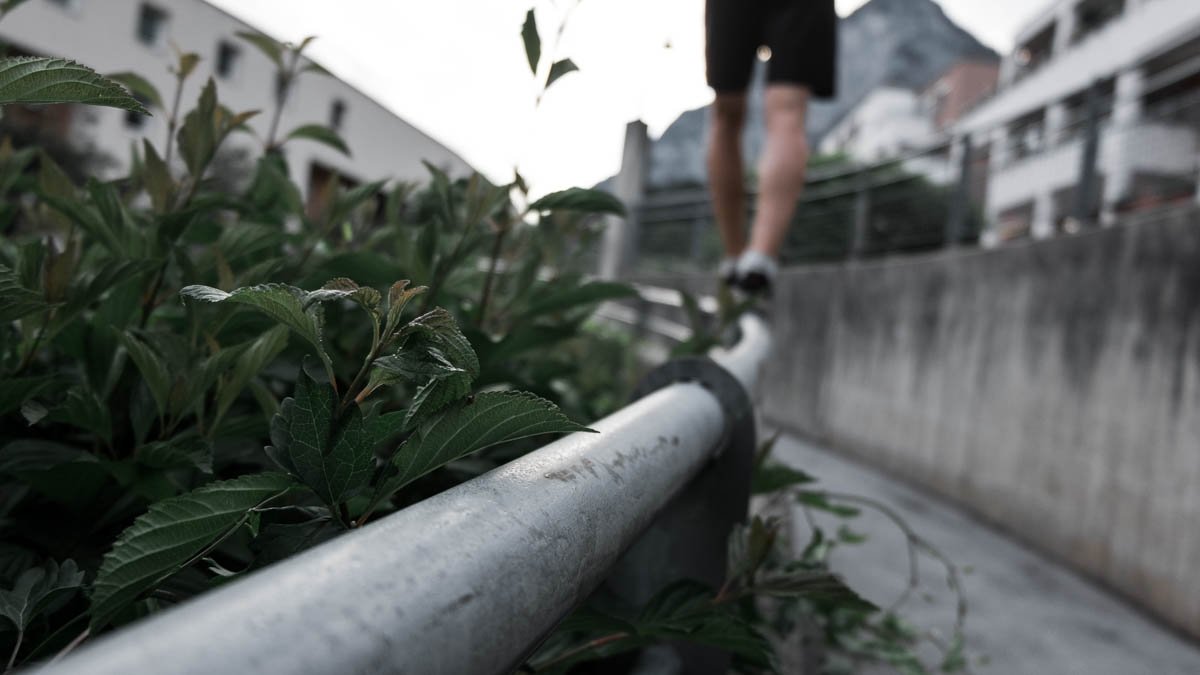
Balance is trainable. Demonstrably.

020406020–2930–392540–4950–5960–693970–7980+54AgeSway path in 20 s, cm · eyes closed · ■ men ■ women

From 40 on, sway grows. Quietly.

At 65 you sway 56 % more with your eyes closed than at 35 and don't notice, because the body compensates. That is exactly what the balance check with Wobble measures: two minutes, four conditions, your score against your decade.

Sources: Goble & Baweja 2018, 6,280 people · Era 2006, 7,979 people

Balance is the base. In sport too.

Athletes who stood badly on one leg before the season had almost seven times as many ankle injuries. Training turns that around: 45 % fewer sports injuries, a third fewer recurrences after a sprain. It won't make you faster, that is what strength training is for. Balance keeps you in the game.

Sources: McGuine 2000 · Lauersen 2014 · Hupperets 2009


Why you don't feel it

Balance is not a muscle. It is the unconscious computation of three senses: eyes, inner ear, body sense. When one fades, the others step in. That is why the decline goes unnoticed for years. And why balance is trained with situations where one sense is missing: eyes closed, soft ground, both together. That is exactly what Wobble measures.

my story

In the dark my balance was suddenly gone.

A good ten years ago we did a training session without light. Balancing on a beam, a few other drills, all in pitch darkness. That's when I noticed I was suddenly behind everyone, even though with my eyes open I had one of the best balances in the group. The others made it across the beam, I kept having to step off. That stuck with me: why is my balance so good with light and so bad without? Today I know, because I can measure it. Wobble measures four conditions: firm and soft ground, each with eyes open and with eyes closed. Soft mat and eyes closed switches off two of the three senses that control balance and tests the inner ear, the balance organ, on its own. In the other three conditions I'm above the average for my age, in this one well below. So in my case the eyes and body sense do most of the work, the inner ear contributes little. With eyes open that never shows.
Wie steht es um dein Gleichgewicht?

Zwei Tests für jetzt. Kein Befund, nur ein ehrlicher Blick.

Test 1 · 3 Minuten · ab 40, auch Sportler:innen

Teste dein Gleichgewicht: Einbeinstand

Stufe 1 · Augen offen. Wie lange stehst du auf einem Bein, ohne abzusetzen?
15 s

Erst schätzen, dann messen.

Stufe 1 · Augen offen, Blick auf einen Punkt. Stopp, sobald der andere Fuß den Boden berührt.
0,0 s
Deckel bei 30 s · Halt in Reichweite

Oder tipp irgendwo auf den Bildschirm.

Stufe 2 · gleiches Bein, Augen zu. Wie lange schaffst du es jetzt?
10 s

Der Durchschnitt liegt mit 35 bei 9 Sekunden, mit 65 bei 3. Erst schätzen, dann Augen zu.

Stufe 2 · Hinstellen, Augen schließen, Timer starten. Stopp, sobald der Fuß aufsetzt oder die Augen aufgehen.
0,0 s
Deckel bei 30 s · Hand an der Wand zählt als Stopp

Oder tipp irgendwo auf den Bildschirm.

Dein Ergebnis
GeschätztGemessenTypisch
Augen offen
Augen zu

Wo stehst du in deiner Altersgruppe? Anonym: nur Jahrzehnt und Werte.

Test 2 · 2 Minuten · ab 65, auch für die Eltern am Telefon

Zwölf Fragen zum Sturzrisiko

Dein Ergebnis
0 von 14 Punkten

Wie haben andere geantwortet? Anonym: nur Punktzahl und Altersgruppe.

Läuft nur in deinem Browser; gesendet wird nur, was du teilst. Vergleich ab 30 Ergebnissen pro Altersgruppe.


Falling can be learned.

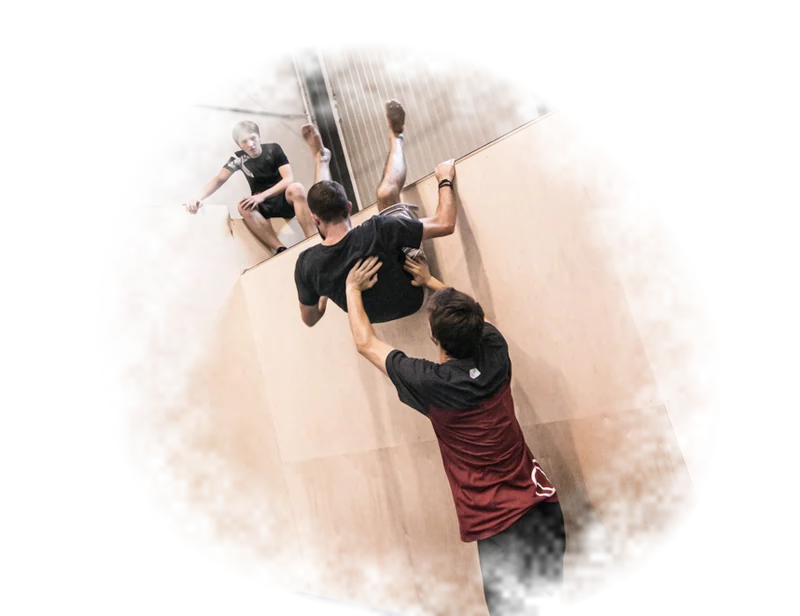
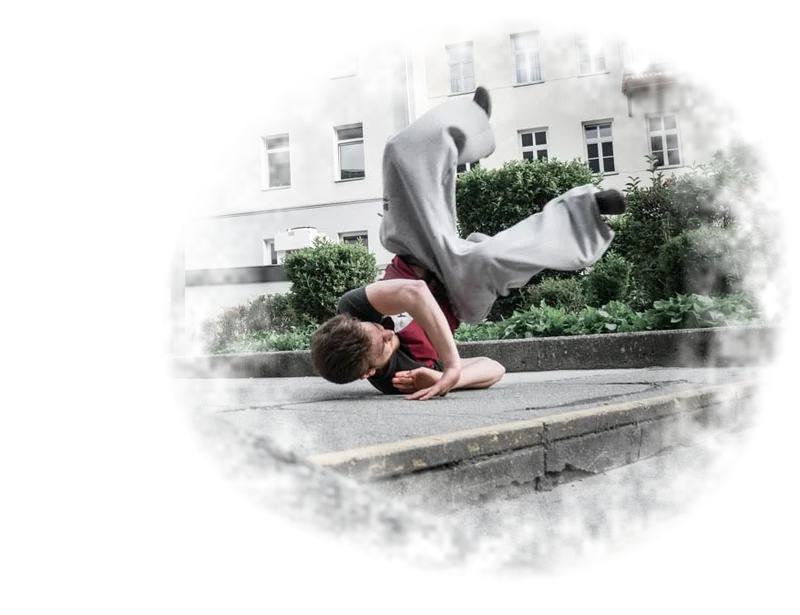
No training prevents every fall. But technique decides whether it ends in a fright or a fracture. I teach it from over ten years of parkour and ukemi, the Japanese art of falling, to two very different groups.

Fallschule: Abrollen
For everyone who wants to stay safe

Falling technique for everyday life

Step by step, on soft ground, no pressure: protecting head and wrists, rolling instead of bracing, and getting safely back up off the floor. That takes away the fear of falling, and less fear demonstrably means fewer falls.

Ukemi Rolle
For athletes, teams & coaches

Ukemi & sport-specific falling technique

For climbers, runners, skiers, ball-sport athletes, cyclists: falling at speed, with equipment, out of movement. 1:1 or as a workshop for teams, clubs and coaches.

Also as a pair or in a small group

I'm happy to teach falling technique to groups of 2 to 6, say both parents together, friends or neighbours. You see how steadily the others stand, walk and fall, and judge yourself more honestly.


Balance check → programme → retest

01

Balance check (free)

At your home: balance check with Wobble, short tests of strength and gait, your story.

02

Programme, 8–24 weeks

One session a week with me, plus your home programme of 10 to 20 minutes.

Prices →
03

Retest

The same tests as at the start, the result in black and white.


What people come to me with

Four examples, there are more.

You've noticed you've become less steady

You reach for the banister more often, you walk more carefully in the dark. Not fate, a training level. And it changes measurably within weeks.

You're worried about your mother or father

A near fall, a hospital stay, or just the feeling that things are getting shakier. I come to their home, do the balance check and say honestly what I see. Training only happens if your parents want it themselves.

After a fall, fracture or physiotherapy

Physio is over, the confidence isn't back yet. I take over the continuation: progressive, measured, over months. Not a substitute for physiotherapy, the follow-on after it.

With dizziness and fear of falling

Fear of falling leads to less movement, less movement to more risk. As a mental coach I work with the fear just as much as with the balance.


Write to me

A quick question or straight to the free first consultation — by e-mail, I reply within 1–3 working days. No newsletter, no sales call.

Postcard to Florian · Innsbruck & Vienna
I would like
Topic, if you like

Reply within 1–3 working days · first consultation free, at your home, outdoors or online · travel in Innsbruck and Vienna included

Where

I use your details only to reply to you. Privacy

Prefer e-mail? me@flof.coach

For doctors, physiotherapists and relatives: same address. With the client's consent I send the test and re-test report as a PDF. Information for professionals →


Questions about fall prevention

There are free fall-prevention courses – why should I pay?

There are, and they're good: the ÖGK health insurer runs “Trittsicher & aktiv”, a free 12-week group course for 65+. I offer what a group course can't: 1:1 at your home, a measurement at the start and the end, training also for people already too unsteady for a group, and all year round.

How often and how long do I need to train?

The guidelines say: three days a week, at least twelve weeks. My model: one session with me, otherwise your home programme, 10 to 20 minutes. First measurable changes usually after eight weeks.

What exactly is the balance check?

A measurement with Wobble, an app I developed myself: the phone on your body measures your sway in four conditions, a training benchmark, not a medical device. Plus short tests of strength, gait and reaction. 20 minutes, included in the free first session, repeated at the retest.

Are you a physiotherapist?

No. I'm a personal trainer specialising in balance (Z-Health Fall Prevention Specialist, FMS/FCS, certified mental coach). I don't diagnose or treat conditions. With dizziness of unclear cause or neurological conditions, a doctor comes first.

What does 1:1 fall prevention cost?

First session with balance check: free. After that 100 € per session or 900 € for a block of 10, travel in Innsbruck and Vienna included. A 12-week programme with one session a week comes to around 1,100 €.